
The project is called the ARCHES Space-Analog Demonstration. It’s a multi-agency, multi-robot mission led by the German Aerospace Center (DLR) with significant European Space Agency (ESA) participation.
The idea is that such autonomous robot networks could be a key future technology, enabling research in harsh, vast environments. We’re talking the surfaces of the Moon and Mars.
Lunar Gateway
Specifically, for the past month, the project team has been exploring the operations and technologies that enable a sample return mission on the lunar surface. This would be involve an astronaut on the Lunar Gateway with a rover operations control room on Earth and scientific expertise on-hand at other control centres.
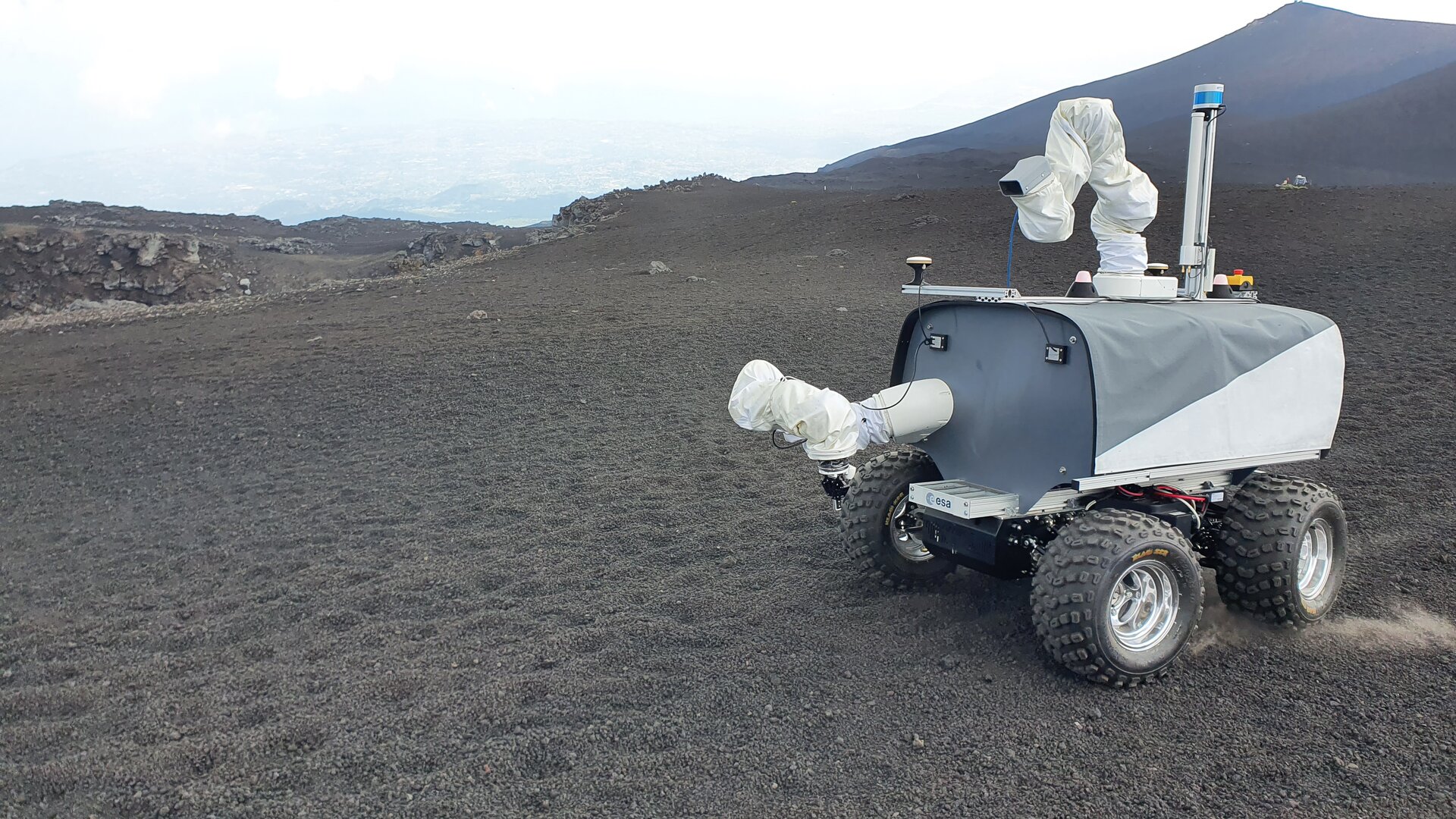
As part of the simulation, ESA astronaut Thomas Reiter was controlling the rover, stationed 2600 m up on the slopes of Mt Etna, from a room 23 km away in the Sicilian town of Catania. Apparently, this distance simulates the sort of remote-control situations astronauts will encounter at the lunar Gateway.
The ESA writes:
“ESA’s 300 kg four-wheeled Interact rover, which is equipped with gripper and camera arms, as well as a stereo camera mast, will be one of the main stars of the show.”
“Interact can deliver much more than images of the environment, however. Its state of the art controls incorporate force feedback that lets astronauts experience the planet’s surface in the same way the rover does – all the way down to the feel of the weight and cohesion of the rocks it touches.”
Long-term
This isn’t the rover’s first outing, as it has received several upgrades to help it weather outdoor use since it was controlled by ESA astronaut Luca Parmitano direct from the International Space Station in December 2019.
It actually marks the culmination of one of ESA long-term robotic research efforts, dating back to 2008.
See also: Picture of the Day: Space-bound magnetometer uses diamond-based quantum technology